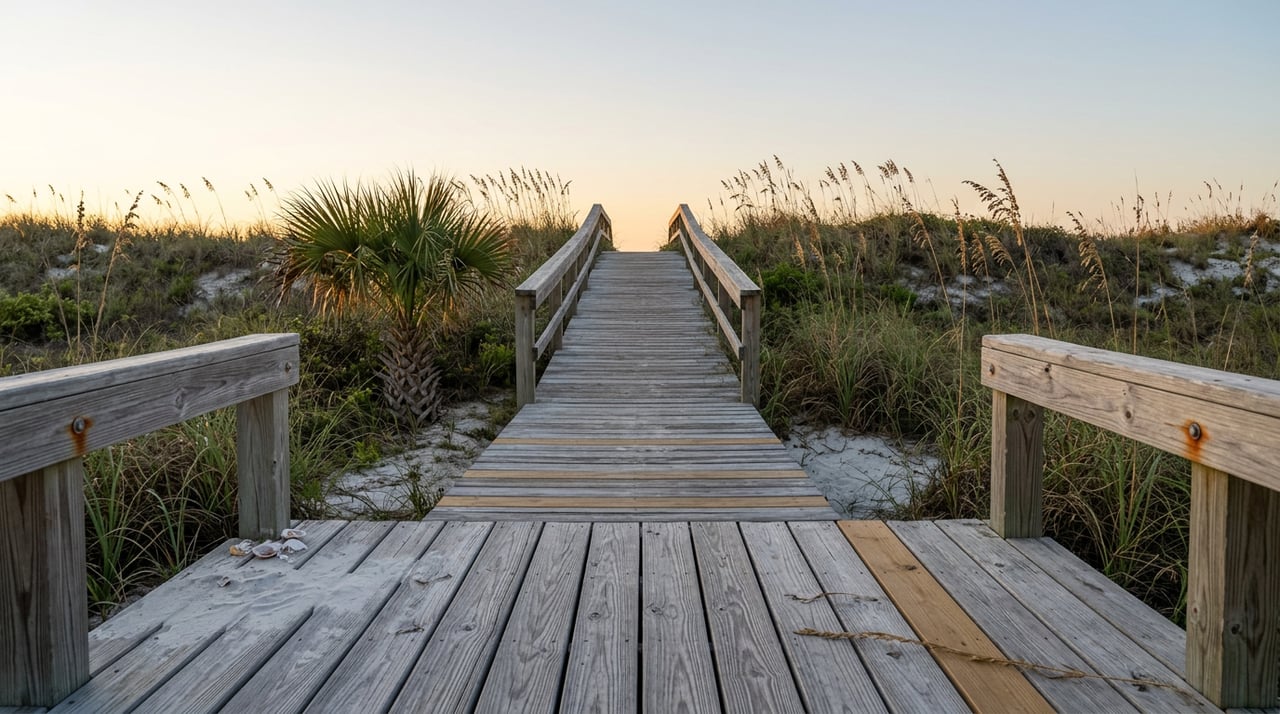
Right now, before most of the island is awake, a truck is still working its way down ten miles of sand, checking on nests that were here well before anyone's second cup of coffee. That has been the rhythm on Kiawah Island since May, and this year the rhythm has produced numbers nobody was expecting.
Sometime around Labor Day, the island's calendar does what it does every year: the farmers market thins out, the concert series plays its last notes, and the parking lots start to empty on weekday afternoons. What's different in 2026 is what's happening underneath that surface change. A record turtle season is only now entering its longest and least visible phase. A new conservation proposal aimed largely at land the island doesn't even sit on is heading toward a vote. And the island's arts season is already restarting before the summer one has finished packing up. None of these things are happening because of each other, but together they say something about how Kiawah actually works day to day, which has less to do with what's visible from a porch this week and more to do with what's happening slowly, or somewhere else.
A Banner Year, With an Asterisk Worth Knowing
As of early August, Kiawah Island Turtle Patrol had logged 495 loggerhead nests for the season, according to a report from News 2's Charleston affiliate. Alison Frey, who has volunteered with the patrol for 14 seasons, told the station the total had already surpassed 2022, previously the program's second-busiest year on record. That makes 2026 the new runner-up season, trailing only the patrol's all-time high.
The context that makes the number mean something: last year was one of the patrol's leanest in recent memory, with roughly 200 nests counted. Going from around 200 to 495 in a single year is more than double, and it's the kind of swing that should make anyone cautious about reading a single season as a trend in either direction. A bad year on Kiawah's beaches doesn't necessarily mean the population is declining, and a great one doesn't mean the pressure is off. Nesting numbers here move with storm cycles, sand temperature, and factors well outside anyone's control on the island itself.
What the patrol controls is what happens next, and that's where most residents lose track of the story. Nesting season on Kiawah typically runs from mid-May into early August, which means by the calendar most people use, turtle season already feels like it's wrapping up. It isn't. The hatching side of the program, which actually determines how many of those 495 nests produce turtles that reach the water, keeps crews working into October. That's a two-month tail on a story most visitors assume ends around Labor Day.
Kiawah's Turtle Patrol covers seven hatching zones, each walked by volunteers on foot every morning looking for the fine tracks that signal an emergence overnight. Three days after the first sign of hatching, the patrol excavates the nest and counts what's left. Residents who volunteer commit to two one-week shifts across the season; visitors and non-residents can sign up for one. The math on the other end of that work is sobering: of every 1,000 hatchlings that make it out of a nest, roughly one is expected to survive to adulthood. That's not a reason to worry about this particular season. It's the reason the patrol treats the next several weeks the same way it treated the peak of nesting back in June.
"If you are out on the beach at night, please do not turn on your flashlight."
That's Frey's guidance to beachgoers this month, and there's enough natural light on the sand without it. Filling in holes before you leave the beach and keeping porch lights and flashlights off after dark aren't seasonal courtesies that end when summer does. They matter for as long as there are nests still incubating, which on Kiawah runs well into fall.
Two Environmental Pushes, and Only One Touches the Island's Own Sand
Residents who followed local coverage this summer may already know that Kiawah's Town Council approved a Beachfront Overlay Zoning District in June, creating buffer zones that limit new construction and additions between oceanfront homes and the island's dune system. That ordinance was contentious. A group of homeowners along Eugenia Street filed suit ahead of the final vote, arguing the new buffer zones went too far, and the council held its ground, with one member pointing to the risk of dune failure and the property damage that would follow if the island's beaches weren't protected as a system rather than lot by lot.
What's newer, and easy to confuse with that zoning fight, is a separate proposal working through council right now: the Kiawah Island Conservation Fund. Where the beachfront ordinance restricts what can be built on the island, this fund is about buying land the island doesn't sit on at all. Councilmember Lance Spencer told News 2 in early August that the fund would pursue conservation easements aimed largely at the Kewa watershed, an area of southern Johns Island just across the causeway.
"Kiawah has a big focus on living with nature."
Spencer's reasoning is worth sitting with because it isn't really about wildlife habitat in the abstract. He tied the fund directly to traffic, water quality, and the everyday experience of getting on and off the island, arguing that what happens on the mainland side of the causeway increasingly shapes what daily life feels like on Kiawah itself. The ordinance is scheduled for a second reading in September, and if it passes, the town plans to stand up an advisory board to guide how the money gets spent.
The distinction matters for anyone trying to keep track of what the town is actually doing. One ordinance is already law and governs what can be built along ten miles of Kiawah's own beachfront. The other is still a proposal, aimed at land several miles away that most residents will never set foot on, but that Council believes will determine how congested, and how quiet, Kiawah feels for years to come.
The Calendar Hasn't Actually Slowed Down Yet
For all the talk of an ending season, the next few weeks are unusually full. The Kiawah Arts Council opens its 2026-2027 season on August 14 with the Marshgrass Mamas, which means the new performance calendar is already underway before the old one has finished. At the same time, Freshfields Village is closing out summer with a run of dated events:
- Farmers Market, Mondays, 3 to 7 p.m., running through the rest of August
- Winedown Wednesday at Showroom, September 2, 3 to 5 p.m.
- Music on the Green, September 4 and 5, 6 to 9 p.m., a two-night send-off for the summer concert series
- Seabrook Island Artist Guild Show and Sale, September 6, 10 a.m. to 6 p.m.
That's a two-week stretch where a new arts season, the last farmers markets of the summer, and a Labor Day weekend concert finale all overlap, which is a busier calendar than the "quiet season" label usually implies. What actually thins out is the crowd, not the programming. Anyone assuming the island goes dark between the last concert and the holidays is working from an old version of how Kiawah spends its Septembers.
What Actually Changes This Time of Year
Line these three threads up and the pattern isn't about an island slowing down. It's about attention moving to things that are harder to see. A record turtle season doesn't resolve in August, it becomes 495 individual, months-long waiting games playing out under the sand. A conservation decision that will shape traffic and water quality on Kiawah is being made about land on Johns Island, not about anything within the town's own borders. And an arts season most people associate with fall and winter has already started before summer's own calendar has closed out.
None of that shows up if you're only watching the beach chairs disappear from the sand. It shows up if you're watching the turtle truck's headlights before sunrise, reading the fine print on a council agenda, or noticing that the Village Green has events booked well past the point most people stop checking.
If you're weighing what any of this means for a home on Kiawah Island, whether it's how the Beachfront Overlay affects a specific lot or how the conservation fund's focus on the Kewa watershed might factor into long-term plans for the island, Charleston Beach Life is a useful place to start that conversation. Russ Knapp has spent more than three decades reading Kiawah's rhythms, the visible ones and the quieter ones, and can walk you through what's changing and what it actually means for a property here. Schedule a free consultation when you're ready to talk specifics.